Four Weeks in Maine: How a Scandal Rewrote the Senate Race in Real Time

The Maine Senate race was supposed to be straightforward. Governor Janet Mills, recruited by Chuck Schumer himself, would take on four-term incumbent Susan Collins in what both parties expected to be one of the most competitive contests of the 2026 cycle.
Then Graham Platner, a 41-year-old oyster farmer and Marine veteran from the Damariscotta region, ran a grassroots insurgency so effective that Mills suspended active campaigning, leaving Platner as the frontrunner. By early May, he was widely treated as the presumptive Democratic nominee, leading Collins by seven points in public polling.
Four weeks later, the race is unrecognizable.
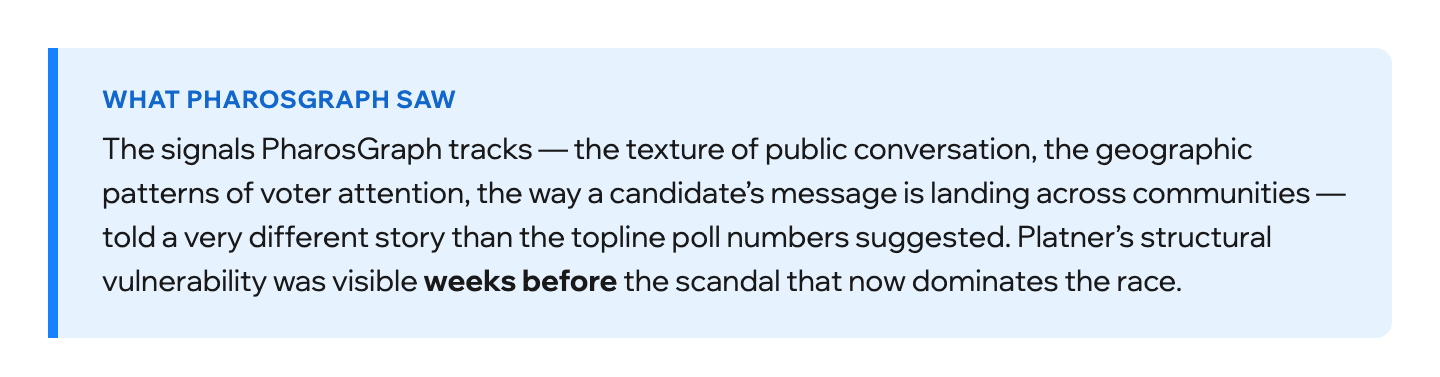
What happened in between is a case study in how quickly a political landscape can shift, and how much conventional polling misses when a race enters turbulent waters. Polls measure where voters say they stand on a given day. They don’t measure the forces already in motion beneath the surface. The signals that PharosGraph tracks, the actual texture of public conversation, the geographic patterns of voter attention, the way a candidate’s message is landing across different communities, told a very different story than the topline poll numbers suggested.
The First Crack: Week of May 14
Mills suspended her campaign on April 30, citing a lack of financial resources after falling behind Platner by double digits in primary polling. By mid-May, Platner was consolidating Democratic support, pulling out of primary debates he no longer needed, and pivoting to a general election message. The coverage was overwhelmingly about his triumph: the outsider who beat the establishment.
But early fractures were already visible if you knew where to look. Concerns over a controversial tattoo from Platner’s time in the Marines had resurfaced, and new questions were emerging about past comments on sexual assault. Rep. Debbie Dingell publicly said she was “very upset.” Sen. John Fetterman openly criticized him.
None of this registered in polls. But in PharosGraph’s analysis of how Platner’s message was actually being received, his ability to persuade voters on policy was already notably weaker than either Mills or Collins. He had the momentum narrative. He did not have the underlying strength to match it.
The Oppo Barrage: Week of May 21
The second week brought a torrent of opposition research. Resurfaced Reddit posts showed Platner mocking a Purple Heart recipient, joking about crude behavior in portable toilets, and fundraising in New York with a jeweler who had called the American flag “a symbol of aggression.”
Public polling still showed Platner ahead by seven points.
But the data underneath was already moving. Platner’s search visibility surged, which sounds like a positive until you understand the cause: people were Googling him because of controversy, not curiosity about his platform. His ability to persuade voters on core issues like cost of living and healthcare actually ticked upward briefly this week, suggesting his policy message still had substance. But the attention was going somewhere else entirely.
Geographic Shift
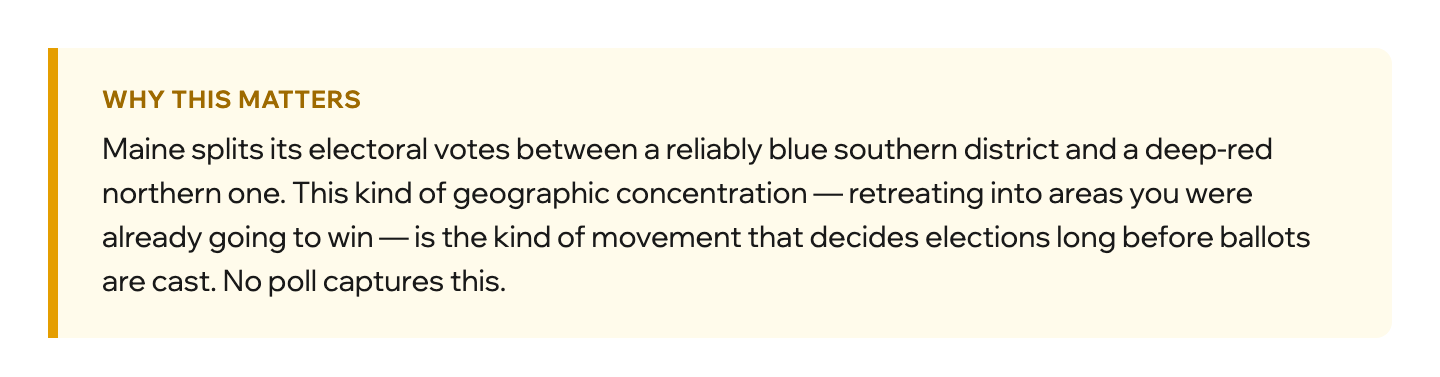
PharosGraph measures candidate appeal at the neighborhood level, tracking how receptive different communities are to each candidate’s message based on the issues those communities care about and how well a candidate’s positions align with them. In early May, Platner’s appeal was broadly distributed, reaching both Portland and Bangor, coastal towns and northern communities. By the end of this week, his support signal had started concentrating sharply in urban areas while eroding in the rural and small-town communities where any Maine Democrat must compete.
The Fracture Goes Public: Week of May 28
The negative coverage intensified and, critically, crossed party lines. Rep. Jake Auchincloss, a Massachusetts Democrat, called Platner’s tattoo and commentary “personally disqualifying,” effectively endorsing Collins over his own party’s nominee. The Washington Free Beacon reported that Platner’s supposedly grassroots campaign had been paying social media influencers for promotion, undermining his authenticity narrative.
The Pan Atlantic Research poll still showed a 48–41 Platner lead. But by this point, the gap between what polls were measuring and what was actually happening in the race had become a chasm.
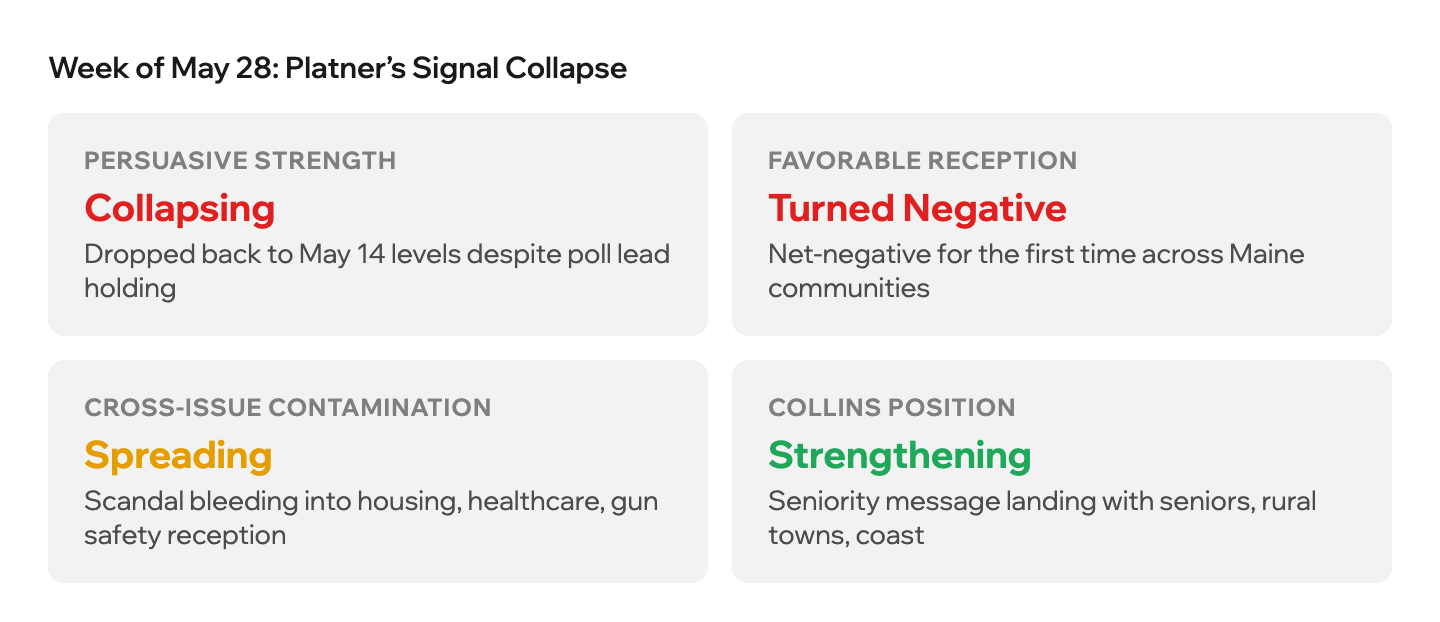
PharosGraph’s voter-level analysis showed Platner’s persuasive strength collapsing, dropping back to where it had been a month earlier. His favorable reception had turned net-negative for the first time across Maine communities. Crucially, the damage was not confined to the scandal stories themselves. It was bleeding into how voters received his message on housing, healthcare, gun safety, and infrastructure. When scandal saturates coverage, it doesn’t just create a new problem. It makes every other message harder to deliver.
Collins, meanwhile, was quietly strengthening. Her seniority-and-federal-funding message played well in the communities where it mattered most: older voters, rural towns, and higher-income neighborhoods along the coast. She didn’t need to attack Platner. The coverage was doing it for her.
The Bottom Falls Out: Week of June 4
On or around May 30, The New York Times and The Wall Street Journal reported that Platner’s wife had alerted his campaign about sexually explicit text messages he sent to multiple women after their 2023 marriage. The story hit every major outlet within 48 hours. Jezebel, Slate, The Atlantic, and The View all weighed in. Betting odds dropped. Schumer backed Platner publicly. Other Democrats panicked privately.
This was qualitatively different from the earlier controversies. Old Reddit posts can be dismissed as youthful indiscretion. Recent infidelity involving explicit messages to at least six women is a character question that lands differently with voters, particularly in a state like Maine where personal integrity still carries genuine weight.
A New Issue Overtakes the Race
By the first week of June, the data showed something remarkable. “Candidate character” had rocketed to the second-most important issue in the race, trailing only cost of living. It displaced Social Security and Medicare, which had held the number-two position consistently for months. That is an extraordinary shift. In a state with one of the oldest populations in the country, where fixed-income concerns are deeply personal, the scandal managed to overtake pocketbook anxiety in voter attention almost overnight.
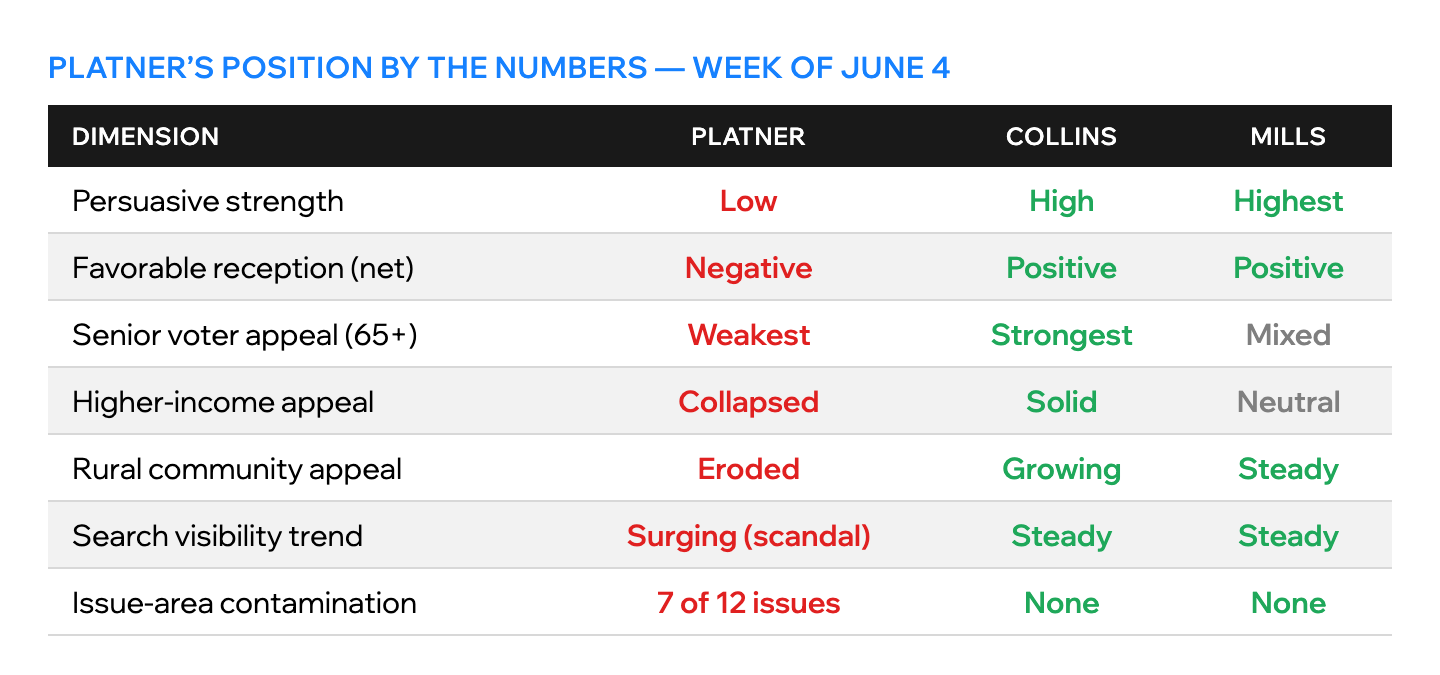
Platner’s persuasive strength dropped to roughly a quarter of where Collins and Mills stood. Not a single issue area showed him in favorable territory. His appeal among higher-income voters, already soft, collapsed to its lowest point. His weakness with voters over 65, already his worst demographic, deepened further. Collins’ strength with those same seniors grew to its highest level of the cycle.
What the Polls Couldn’t See
The conventional read on this race, as recently as late May, was that Platner was a flawed but leading candidate with a real shot at unseating Collins. The polls said so. The fundraising trajectory said so.
But polls are snapshots. They capture stated preference at a moment in time. They cannot tell you that a candidate’s message has stopped landing in the communities where it needs to land. They cannot tell you that a scandal is not just generating bad headlines but actively contaminating a candidate’s ability to be heard on housing, healthcare, or the opioid crisis. They cannot show you, at the neighborhood level, that a candidate’s support is retreating from rural Maine into an urban core that was already going to vote Democratic anyway.
PharosGraph measures all of this. Not through polling, but through continuous analysis of how political conversation actually moves through communities, which issues are rising and falling in voter attention, how candidates’ messages are being received across different geographies and demographics, and where the real competitive pressure points are.
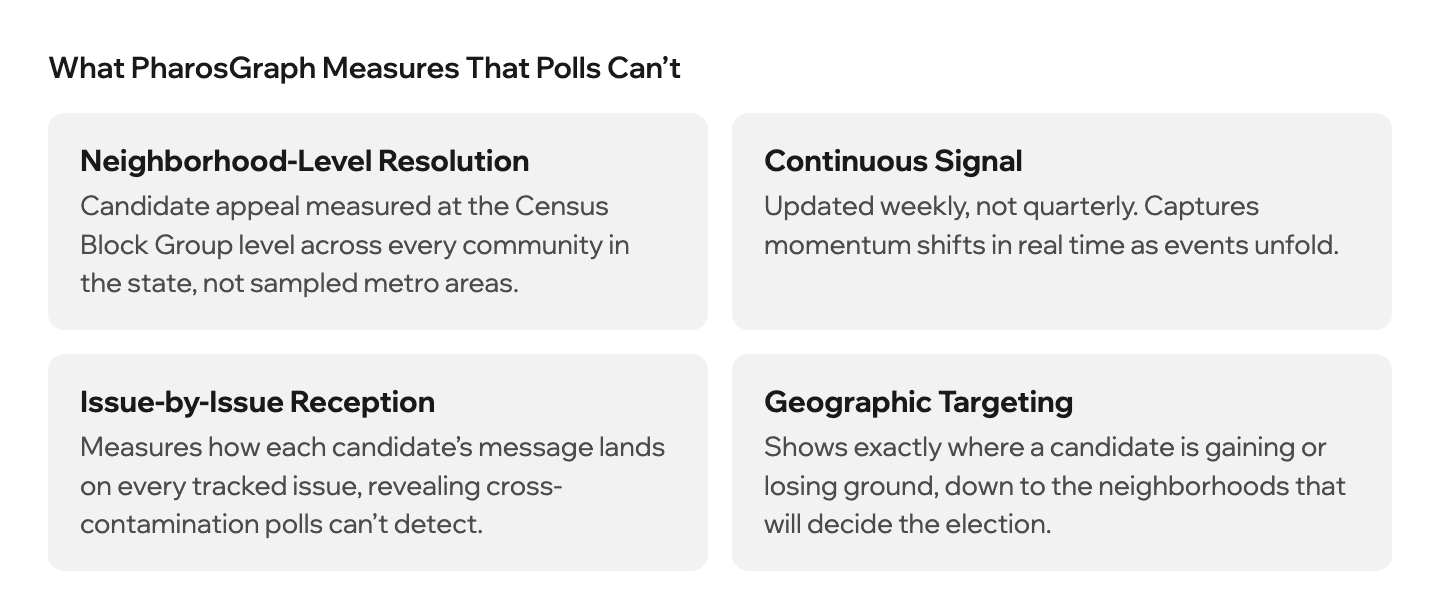
In the Maine Senate race, that analysis identified Platner’s structural vulnerability weeks before the sexting scandal broke. His momentum was flagged as deteriorating in mid-May, at a time when he was still leading in polls by seven points. The geographic concentration of his support, the erosion of his rural signal, the growing disconnect between his visibility and his persuasive strength: these were all measurable before they became conventional wisdom.
Where the Race Stands Now
Four days before the primary, this race has three possible trajectories.
If Platner survives the primary, Collins faces a weakened opponent whose ability to persuade swing voters has been severely degraded. The scandal has not just hurt him with Republicans and independents. It has fractured his own party’s willingness to stand behind him. Democrats defending Platner publicly while distancing themselves privately is not a formula for a competitive general election in November.
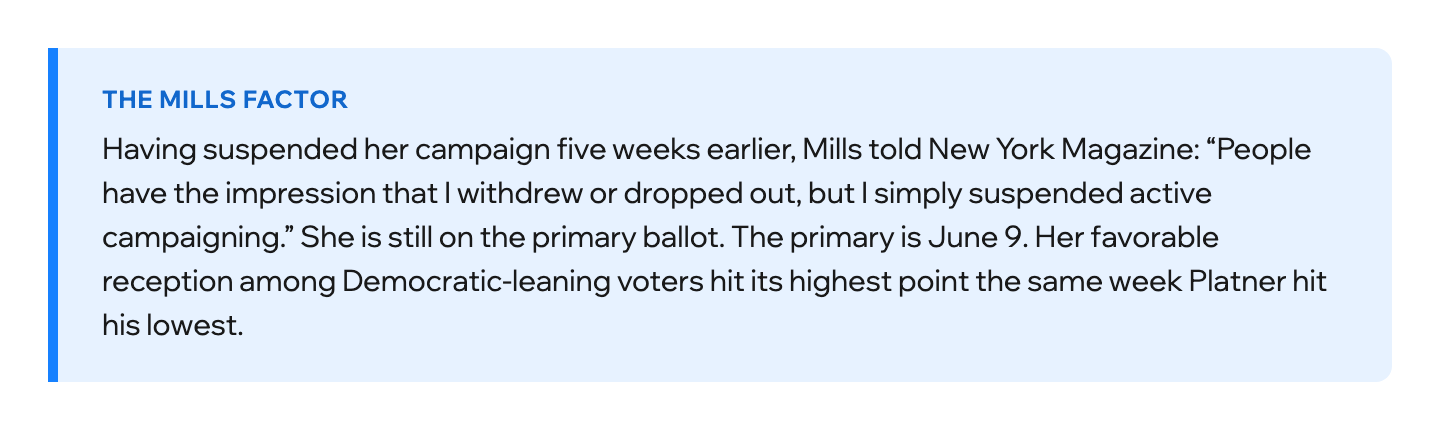
If Mills’ “still on the ballot” signal translates into actual primary votes, Maine Democrats may get a do-over. Mills’ standing in the data has quietly strengthened throughout the scandal period. Her favorable reception among Democratic-leaning voters hit its highest point the same week Platner hit his lowest. Her persuasive strength on policy has trended steadily upward. She would enter a general election against Collins as a known, credible candidate without the baggage.
And Collins, the four-term incumbent whose vulnerability was supposed to define this cycle, now looks like the most stable figure in the race. Her persistent weakness on abortion and judicial appointments remains real. But in a contest where her opponent’s character has become the dominant issue, her decades-long brand as a steady, independent-minded senator is working in her favor in ways that would have been hard to predict two months ago.
The Maine Senate race is a reminder that the most important movements in a campaign often happen below the surface, in the shifting patterns of voter attention and community-level reception that no single poll can capture. Understanding those movements in real time is the difference between reacting to a headline and seeing the forces that will shape the next one.
PharosGraph provides continuous, neighborhood-level political intelligence for campaigns, media organizations, and political analysts. To learn more about how our data can transform your understanding of competitive races, email: info@pharosgraph.com

Four Weeks in Maine: How a Scandal Rewrote the Senate Race in Real Time

The Suburban Bloc That Could Swing the 2026 Texas Senate Race